
The next time I got out on the beach the waves were back up and so was the wind which was coming from the south west. It was overcast and stayed that way most of the day with periodic times when it would clear up with momentary sun. It was actually a dreary day, if it is possible to have one on a Florida beach. The water was grey and dirty next to the shore where the waves crashed in churning up the sand and shells. Then going out a few feet the water turned to a sandy, milky green color and out 20 feet or so the water cleared up. There was an obvious current moving from south to north.

The waves were coming in every 3-8 seconds, were 2-3 feet high and big enough to put you off-balance or knock you down if not careful. On a big wave I would stand sideways to lessen the force. Even though it was impossible to spot any fish, I wasn’t about to go home without trying to catch a snook. There were areas on the beach where the bottom was flat and shallower, and areas where there was a several foot drop off into a trough running along the beach.

After rigging up my fly rod with a floating fly line, a 10 foot leader with 3 feet of 25 lb fluorocarbon tippet, I tied on a #2 “Holy Mackrel”, a Clouser style fly tied out of Ultra Hair. At this point in my salt water fishing experience, this is my “go to” fly I have the most confidence in. It is a minnow pattern that I have caught mackerel, , redfish, pompano, sea trout and flounder on in the past. The fly was heavily weighted with large, red, barbel eyes. I felt a heavy fly was needed to get down below the waves. Confidence in the fly has always been important to my fishing. If you believe in the fly, connecting with the fish seems to follow, most of the time. I selected a “fishy looking” spot where the trough faded out into a deeper area. I waded out a few feet into the surf and began casting to my left, parallel to the beach and straight down the trough. I heard that snook travel down the trough close to the beach so that is where I started casting.
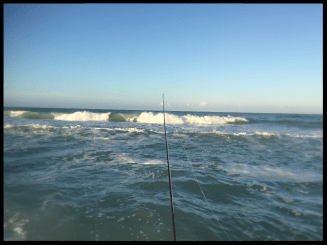
The waves were so strong that they would take my floating line and wash it back onto the beach. After several frustrating casts, I realized that I should be using an intermediate sinking line that would sink down into the water below the chop, and not get washed ashore as easily. I changed to a clear, intermediate fly line with 4 feet of 25 lb fluorocarbon tippet to the fly. Because the waves were coming in at an angle from my left or south, and the wind was coming from the south, I couldn’t cast to my left or the waves and wind would push the fly line back into my position and I would have a tangled mess.

I changed direction and facing north I began working the beach from my left to my right. The wind was now at my back, the waves were taking my loose fly line away from my feet, the intermediate fly line was sinking below the waves, and now I just had to time the cast to hit the water right after the wave crashed into the shore and before the next one came in. I was working the water in a systematic way, starting parallel to the shore at the edge of the trough, then casting out to a perpendicular angle straight out in front of me. It was nice to have a long 10 foot rod that could extend out past the incoming waves.
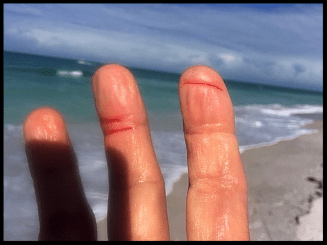 I fished for a half hour until I got my first hard strike. I set the hook and the fish was on. It felt like a good one. I quickly got him on the reel. He made several runs and then several jumps when he got closer, about 20 feet out. Sure enough I could see the black, lateral line stripe and silver body of a 20″ snook. As the fish got closer and I thought I could control him, I made the mistake of reaching down and grabbing the tippet while he was still hooked up. At the same time the snook took off again and the fluorocarbon tippet zoomed through my fingers cutting a small but painful slice in my fingers. A bloody mistake I will remember not to make again. I was learning that salt water fish, especially snook have a lot of power!
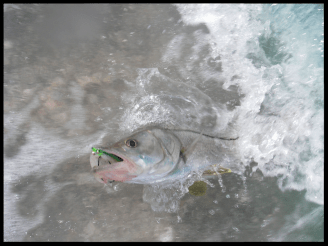
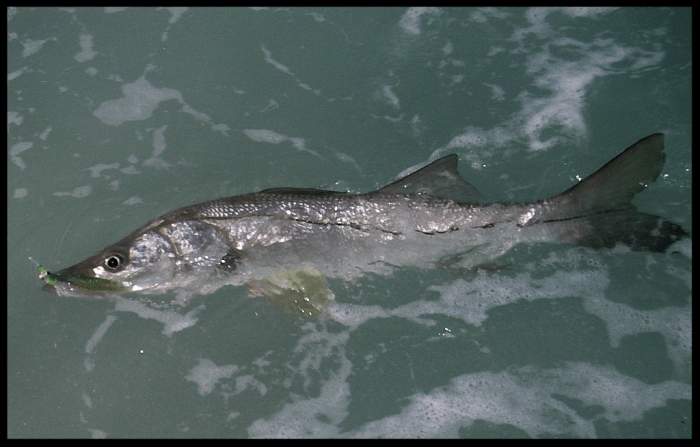
I finally got him close, waded out into the surf,cradled him in my hand and arm and removed the barbles hook. Letting him go he disappeared back into the water, like a ghost. By noon I had hooked and landed three more, all about the same size. The wind and waves had increased to an impossible level. making fishing next to impossible. While walking back down the beach to my parking spot with a big smile on my face, I marveled at the power and jumping ability of the snook I had caught. I wondered what fighting a really large one would be like. I was satisfied with my first day of snook fishing on the beach. At least I had begun to “crack the code” of beach fishing for snook, even if I couldn’t see them under the poor conditions. I had waited a long time to spend a day on the beach, now only a few miles from my new home. I’ll certainly be back. In good weather or bad!
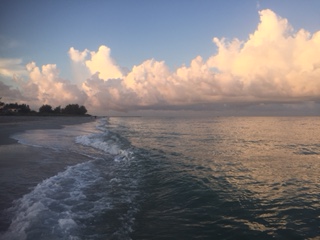

 The next time I went out exploring the beach everythng had changed. I carried my rod but didn’t even string it up. There were 3 foot waves and 15 mile an hour winds coming from the south-west. There had just been a tropical storm out in the Gulf. I noticed currents flowing north along the beach and then south. There were also backwashes and undertows where the water went out perpendicular to the beach shore line. There were even surfers out riding the bigger waves. The waves had churned up a sandy, milky, green color to the water and visibility into the water was impossible out for 20-30 feet . Not the best conditions for seeing snook and sight fishing. I saw no fish.

 A COLORADO FLYFISHERMAN GOES SALTY